Gayatri (Gaya) Datar came to the GSB to pair rigorous business education with her international experience. She found her calling in the class Design for Extreme Affordability, inspiring her and teammates from Medicine and Engineering to travel to Rwanda to confront poverty firsthand.
They found families suffering from preventable illness, children missing school, and adults unable to work — not because of some distant crisis, but from the ground beneath their own feet. Dirt floors, common across Rwandan homes, bred disease-carrying pests, kicked up asthma-inducing dust, and harbored waterborne pathogens. Something as basic as where a family slept and ate was silently making them sick.
Gaya and her team returned to the GSB with an idea: a flooring alternative, cheaper than cement, built from local, natural materials. After several early dead ends, a classmate and Biochemistry Ph.D. candidate found the missing piece — an oil available in Rwanda that dried into a durable, cleanable resin seal.
Upon graduation, Gaya didn’t just launch a company — she moved to Rwanda to train local workers to build healthy floors, one home at a time. She called the company EarthEnable. A mission this ambitious needed a first believer, and that first believer was Project Redwood.
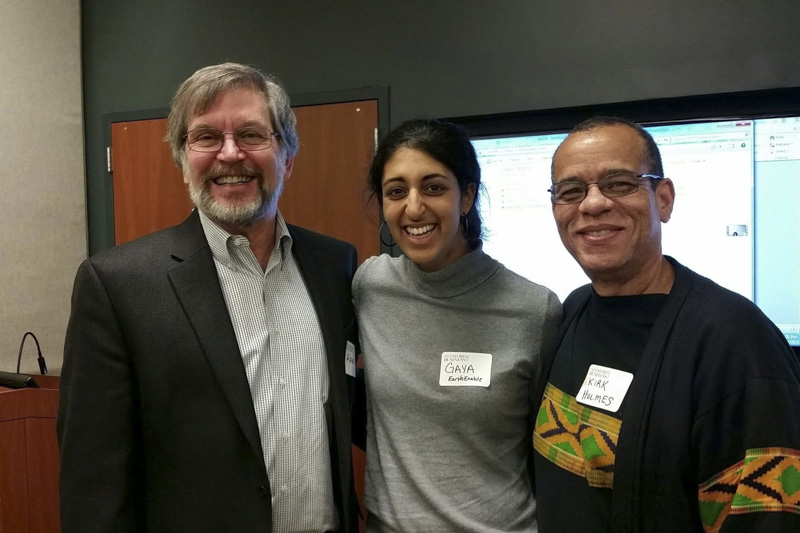
In 2014, Kirk Holmes heard about Gaya’s work, and after listening to Kirk Renaud speak about the mission and grantmaking of Project Redwood at a D.C. alumni event, the two joined forces. A conversation with Gaya followed. The two Kirks immediately recognized that Gaya was exactly the kind of social entrepreneur, and EarthEnable the type of poverty-eliminating organization, that Project Redwood wanted to support. They backed her — sponsoring EarthEnable’s grant applications over three years and continuing as EarthEnable friends and advisors to this day.
Gaya still remembers what that first trust meant: “They took a risk by granting to us, and that helped us build credibility to bring in other funders.”
That risk has since become a movement. From floors to full homes, EarthEnable is revolutionizing the housing industry in Rwanda, Kenya, and Uganda. In the process, EarthEnable has created thousands of jobs and improved more than 200,000 lives.
In 2025, Gaya and EarthEnable won the Skoll Award for Social Innovation for transforming communities in East Africa through economically viable, green housing. Gaya believes the same solution can reach the 1.8 billion people worldwide still living without safe housing — and it started with the GSB and two Kirks willing to bet on her.