What if a child’s access to a great education didn’t depend on where they were born—or whether their school had electricity, Wi-Fi, or a library?
That question has driven the work of Antonio Purón and David Sowerwine, two Stanford GSB alumni who connected with Project Redwood as grant applicants. Though they were working on opposite sides of the world—Antonio in Mexico and David in Nepal—they shared a belief that technology could expand educational opportunity for children growing up in poverty.
Project Redwood saw the potential in their ideas and provided support that helped both organizations strengthen their operations and accelerate their growth.
Antonio Purón: Reimagining How Children Learn
Antonio Purón (right) in conversation at Stanford
After the GSB, Antonio returned to Mexico and joined McKinsey & Company. Troubled by an education system where rote memorization too often replaced critical thinking, he assembled a team of educators, psychologists, and project managers to create Inoma, a nonprofit dedicated to learning through play and technology.
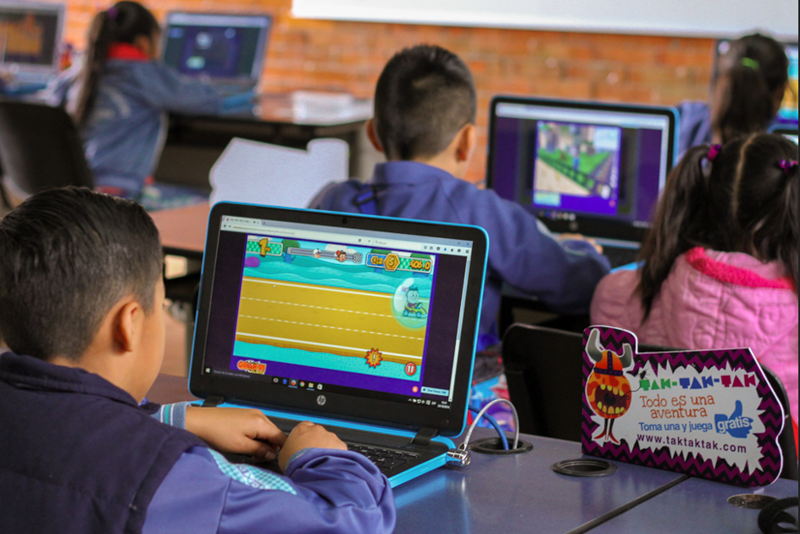
Its flagship platform, TAK-TAK-TAK, uses personalized educational games to teach mathematics, science, language, history, and the arts. Designed to work online and offline and available in three languages, it helps overcome barriers created by limited internet access.
Today, more than 400,000 children actively use TAK-TAK-TAK throughout Latin America and beyond. An independent evaluation has shown significant mathematics gains among students, evidence that will open doors to new opportunities for Inoma to expand. Project Redwood’s support helped Inoma move from a promising idea, toward a solution capable of reaching children at scale.
David Sowerwine: Bringing Education to Remote Schools
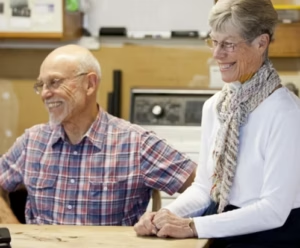
David and Haydi Sowerwine working together
Half a world away, David and Haydi Sowerwine founded EcoSystems Nepal to develop affordable technologies for rural communities. Together with computer engineer Skip Stritter, they focused on elementary education, where schools often lack funding, teaching materials, electricity, and Wi-Fi.
Their answer was Looma—a portable, solar- and battery-powered computer and audiovisual projector housed in a one-by-one-foot plywood case. Looma gives teachers access to libraries, textbooks, videos, games, and interactive lessons, dramatically expanding what students can experience in the classroom.
Today, Looma is used in 88 schools across Nepal, reaching up to 10,000 students each year. David is now developing Looma Education Nepal, a locally-led organization designed to sustain and expand the program for future generations.
Two countries. Two very different challenges. One shared belief.
Antonio and David began with ideas inspired by what they saw around them. With Project Redwood’s investment and support, those ideas became stronger organizations and scalable solutions.
Together, Inoma and Looma are helping to bring high-quality education to children who might otherwise have limited access to it—and demonstrating how investing in visionary leaders can create lasting change through one of the most powerful tools for breaking the cycle of poverty: education.